
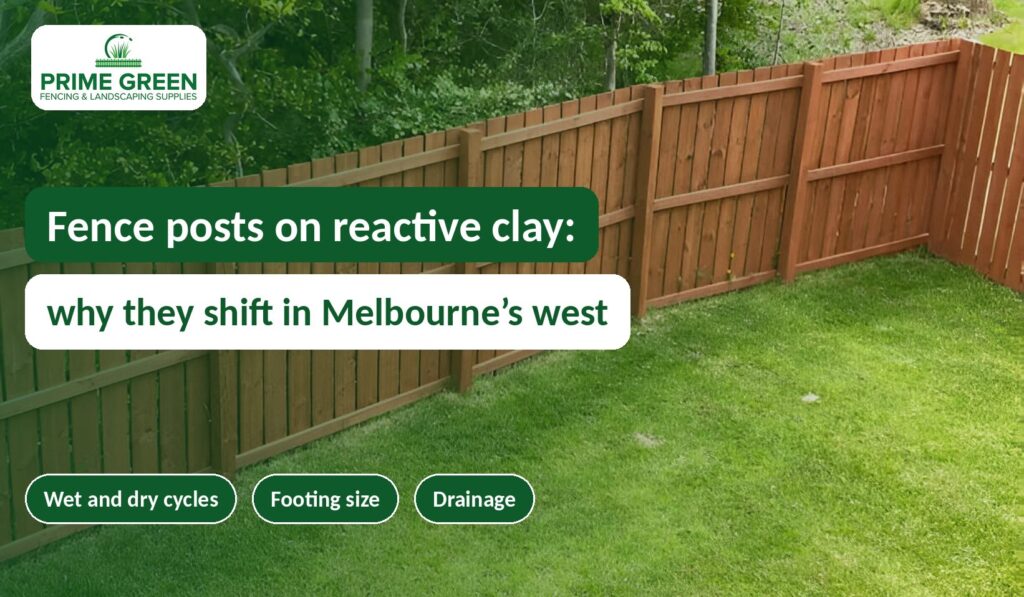
If you have ever watched a fence start to lean a few years after it went in, the palings were probably not the problem. Much of Melbourne’s west sits on basalt plains, and the clay that has formed from that rock swells when it is wet and shrinks as it dries. Researchers who study ground movement in these suburbs describe the soils as highly reactive, strong enough to crack lightweight houses built on shallow footings. A fence post is a far smaller structure than a house, but it is buried in exactly the same ground.
What reactive clay does to a fence post
A post set in concrete looks permanent, yet the soil around it is rarely still. After a wet winter the clay swells and presses against the footing. Through a long dry summer it shrinks and pulls away, leaving a thin gap around the concrete. Rain then runs straight down that gap, softens the soil at the base and keeps the timber damp. Repeat that cycle for a few seasons and a post that started out plumb can begin to rock, twist or lean.
Nothing about this means a fence in the west is a bad idea. It means the footing deserves as much thought as the fence panels, particularly on the new estate blocks around Tarneit, Truganina and Wyndham Vale where the ground has often been cut, filled and levelled.
Signs your fence posts are on the move
Movement tends to show up slowly, so it helps to know what to look for when you walk the fence line:
- A visible gap between the soil and the concrete collar at the base of a post.
- A top line that no longer runs level, or palings that have started to fan out.
- Gates that drag on the ground or latches that no longer meet their catch.
- Cracks in the soil running along the fence line during summer.
- Posts that rock when you push on them firmly with your hand.
One loose post is often fixable. Several in a row usually point to a wider issue with drainage, footing size or the type of post, and that is worth sorting out before the rails and palings are affected.
Choosing posts for clay ground
The post you choose affects how the fence copes with seasonal movement. Treated pine and hardwood posts are the usual choice for a timber fence, and the grade you pick matters because the base of the post lives in damp ground for most of the year. Our earlier guide to fence post types compared walks through the main options, and it is a good place to start if you are weighing timber against steel.
Galvanised steel posts do not rot, which removes one of the problems that clay creates. They are widely used where ground movement is a concern, including in steel post retaining walls. Steel still needs a properly sized footing, though. A stronger post in a poorly set hole will still shift.
Setting the footing so it can cope
Footing depth and size depend on the height of the fence, the type of fence and the soil on your particular block, so there is no single measurement that suits every yard. A few principles do apply on reactive ground:
- Dig through the dry, cracked surface layer so the footing sits in soil that stays more consistently moist.
- Avoid leaving a flat shelf of concrete at ground level. Finish the top so water sheds away from the post instead of pooling against it.
- Keep the footing a sensible size for the fence height. Tall or solid fences catch more wind and put more load on each post.
- Make sure the concrete is fully cured before the rails and palings go on.
If you are not sure what is in the ground on your block, ask your installer to check it before the posts are set. A few minutes with a shovel can tell you a lot.
Look after the moisture around the fence line
Reactive soil moves most when its moisture content swings between extremes, so the aim is to keep conditions around the fence as steady as you reasonably can. Direct downpipes and stormwater away from posts, because a constant stream of water at one spot makes that section move more than the rest. Be careful about planting large trees close to a fence, as thirsty roots pull water out of clay and speed up shrinkage. If summer cracks open along the fence line, a gentle, even watering can help the soil close up again, but avoid soaking one area heavily.
Sloping blocks need extra attention, because water naturally collects at the low end of the fence. If your yard drops away or sits behind a retaining wall, make sure the drainage behind the wall is working. Our guide to retaining wall drainage explains what should be behind the wall and why it matters for anything built nearby.
Planning ahead for your own block
Before you order materials, take photos of the fence line, note where water runs after rain and measure the lengths you need. If you live in Tarneit, our Tarneit fencing and landscaping supplies page shows what we commonly supply for that part of the west. Good planning now means fewer surprises when the clay does its seasonal shuffle. No fence can be guaranteed against ground movement, but a well chosen post and a well made footing give it the best chance of staying straight.
Frequently asked questions
Do all fences in Melbourne’s west have trouble with reactive soil?
No. Soil conditions vary from street to street and sometimes from one end of a block to the other. Some yards have heavy clay close to the surface, while others have fill or rock. That is why checking your own ground before building is worth the effort.
Can a leaning post be fixed without replacing the whole fence?
Sometimes. If the post is sound and only the footing has loosened, it may be possible to re-set it. If the timber has rotted at the base or several neighbouring posts have moved, replacing the affected posts is usually the more reliable option.
How is a leaning post different from a fence that needs replacing?
A single leaning post with solid timber and straight rails is a repair job. A fence with soft or crumbling post bases, rails pulling away and many posts out of line is closer to the end of its life, and a rebuild can make more sense than patching it.
Should I worry about the neighbour’s trees and drainage?
It is worth noticing them. Large trees and runoff from a neighbouring downpipe can change how much moisture is in the soil along a shared fence line. If you suspect they are causing movement, a friendly conversation early is easier than a dispute later.
What should I ask an installer about my soil?
Ask how they will set the posts on your block, what footing size they plan to use for the height of your fence, and how they will handle any drainage issues on the fence line. A clear answer tells you they have thought about your ground, not just the fence panels.
Talk to Prime Green Fencing about your fence line
Planning a fence on clay ground? Drop in to our Truganina yard at 26 Apex Dr, Truganina VIC 3029, or call 0452 113 113, and bring a few photos of your fence line. We will help you match posts, lengths and materials to your block, so your new fence is set up for the way the ground behaves in the west.