
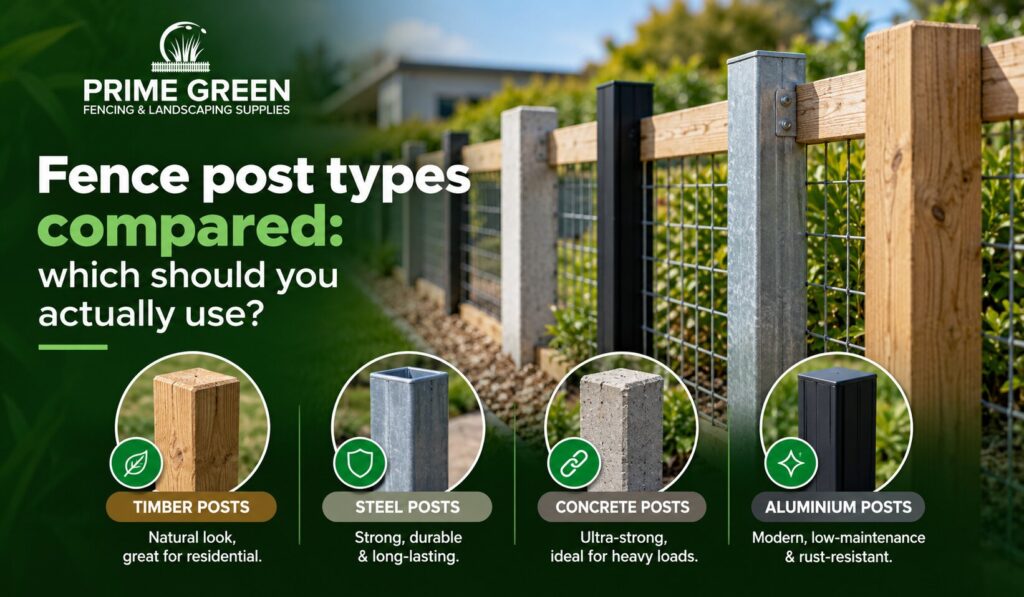
Palings get all the attention, and they are the part nobody should worry about. Posts are what decide whether your fence is still straight in fifteen years.
Almost every timber fence that fails in Melbourne fails at the post, at ground level, while the palings above are still perfectly serviceable. So the post is the component worth thinking hardest about when you are choosing fencing materials, and it is also the one where the price difference is smallest relative to what it buys you.
The options at a glance
| Post type | Typical life | Relative cost | Best suited to |
| H4 treated pine | 15 to 20 years | Lowest | Standard suburban paling fences on stable ground |
| Galvanised steel | 25 years plus | 30 to 50% above pine | Reactive clay, long runs, fences you do not want to revisit |
| Hardwood | 20 to 30 years | Well above pine | Feature fences, rural runs, longer spans |
| Concrete | 40 years plus | Highest to install | Specific applications, often with concrete plinths or sleepers |
The life figures assume the post is installed properly and the ground drains. Neither is guaranteed, and both matter more than the material does.
H4 treated pine
The default across Melbourne and a perfectly reasonable choice for most suburban fence lines. H4 is the treatment level rated for in-ground contact, and it is the minimum you should accept for a post. H3 is rated for outdoor use above ground and will not last in a post hole, so it is worth checking what you are actually buying rather than assuming.
Pine posts fail at the soil line, where oxygen, moisture and organisms all meet. The timber below and above that zone is often still sound when the post snaps. Nothing you do to the visible part of the fence changes this.
Where pine makes sense: straight runs, reasonable drainage, standard 1.8 metre paling fences, and situations where replacing the fence in two decades is acceptable.
Galvanised steel
Steel posts cost more at purchase and comfortably outlast the palings attached to them. Across the western suburbs, where reactive clay swells and shrinks seasonally, they are often the better economic decision rather than the premium one.
The reason is specific. Seasonal ground movement works at the post where it enters the soil, which is the same zone where pine is already most vulnerable. Steel is indifferent to it. On heavily reactive sites, this tends to settle the argument regardless of budget.
Steel also stays straighter over long runs and handles wind loading better, which matters on exposed blocks and newer estates where there is little established planting to break the wind.
Worth knowing: Colorbond fencing uses its own integrated steel post and rail system, so post choice is not a separate decision there. It is part of the product.
Hardwood
Strong, long-lived and considerably heavier to work with. Hardwood posts suit longer spans, which is why they turn up on rural and acreage fence lines where post spacing is wider, and the fence is doing a different job.
On a standard suburban paling fence, hardwood is usually more posts than the fence needs, and the cost difference is hard to justify against steel.
Concrete
Concrete posts and plinths appear in specific situations rather than as a general option. A concrete plinth at the base of a timber fence keeps palings out of contact with soil and mulch, which extends paling life significantly on garden boundaries.
Full concrete post systems are durable and essentially maintenance-free, but they are heavy, less forgiving of a set-out error, and usually chosen where the fence is doing structural or retaining duty as well.
Spacing, depth and the things that actually cause failure
Material choice matters less than installation. Three things do most of the damage.
Post spacing
Around 2.4 metres is common practice for a standard 1.8 metre paling fence. Taller fences, exposed sites, heavier palings and wider palings all call for closer spacing. Stretching spacing to save on posts is a false economy that shows up as sag within a few years.
Footing depth
A rough working guide is a third of the post height in the ground, deeper on reactive clay or exposed sites. A 1.8 metre fence therefore wants a meaningful hole, not a token one. Shallow footings are the single most common cause of a fence that leans after its first wet winter.
Concrete and drainage
A post set in a concrete collar that traps water around the timber can rot faster than one in well-drained soil. The detail matters: concrete should be finished so water sheds away from the post rather than pooling at it, and a drainage layer of aggregate at the base of the hole helps considerably.
These figures are general practice, not engineering specifications. For tall fences, retaining applications, exposed sites or anything structural, follow engineering advice or manufacturer specifications rather than a rule of thumb.
So which should you choose?
- Standard suburban paling fence, reasonable drainage, budget conscious: H4 treated pine.
- Reactive clay, long runs, exposed block, or a fence you want to forget about: galvanised steel.
- Rural or acreage line with wide spans, or a feature fence: hardwood.
- Fence line against garden beds or mulch: any post type, but add a concrete plinth to protect the palings.
- Going with Colorbond: the post system comes with it, so the decision is made for you.
For most new builds across Point Cook and the western suburbs, the honest answer is that steel posts with timber palings is the combination that gives the best result per dollar over the life of the fence.
Frequently asked questions
Can I mix steel posts with timber palings and rails?
Yes, and it is one of the most common builds in Melbourne. Steel posts with timber rails and palings gives you the appearance of a timber fence, with the component that fails first replaced by one that does not.
What is the difference between H3 and H4 treated pine?
H3 is rated for outdoor use above ground. H4 is rated for in-ground contact. Posts go in the ground, so H4 is the minimum. Rails and palings sit above ground and are commonly H3.
Do fence posts have to be set in concrete?
Not always, but it is standard practice for paling fences in Melbourne and strongly advisable on reactive clay. Compacted aggregate alone can work on stable, well-drained ground, though it offers less resistance to movement over time.
How deep should a fence post go for a 1.8 metre fence?
As a working guide, around a third of the post height in the ground, with more depth on reactive clay or exposed sites. Confirm against manufacturer guidance for the specific system you are using rather than treating that as a fixed rule.
Are steel posts worth the extra cost?
On reactive clay across Melbourne’s west, usually yes. The purchase difference is modest compared with the cost of dismantling and rebuilding a fence around failed posts, which is the job you avoid.
Talk to us about your fence line
Prime Green Fencing supplies H4 treated pine posts, galvanised steel posts, hardwood, rails, palings and fixings from our Truganina yard. Tell us the fence height, the run length and the ground you are working with, and we will tell you what will still be standing straight in fifteen years.
Call 0452 113 113 or visit 26 Apex Dr, Truganina VIC 3029. We deliver across Point Cook, Werribee, Tarneit, Hoppers Crossing, Truganina, Melton and the wider western suburbs.