
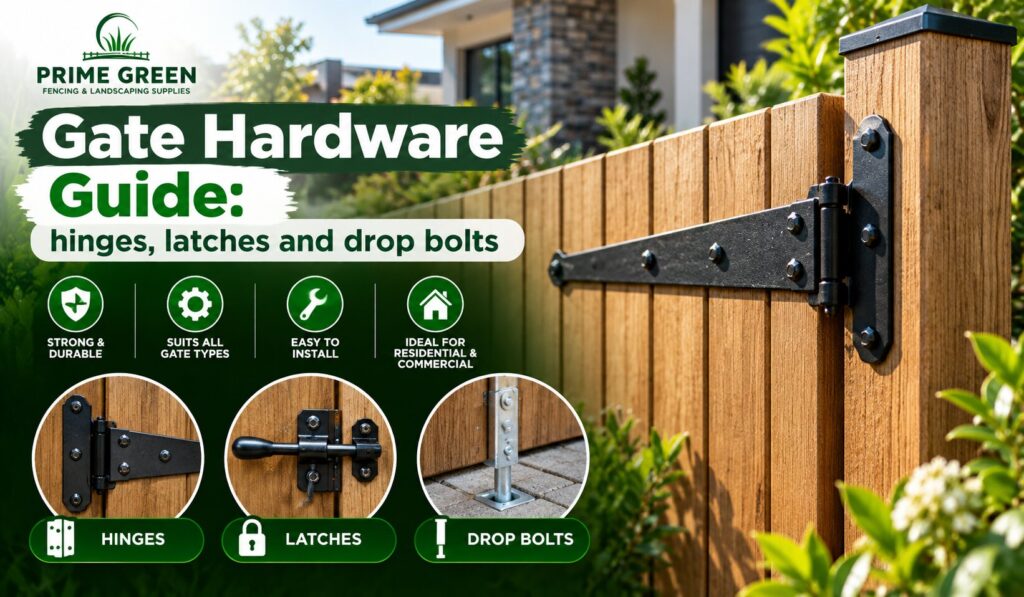
A fence either stands or it does not. A gate has to work every single day, and that is why gates are the part of a fence people complain about.
The gate drops, catches on the path, stops latching, and eventually someone props it open permanently. Almost always the timber is fine, and the problem is the fencing hardware, or the post it is hung on. Here is how to choose components that still work in five years.
Start with the post, not the hinge
A gate is a lever. Every bit of its weight pulls on the hinge post, all day, every day, and it pulls hardest at the top hinge.
Which means the most common cause of a sagging gate is not a cheap hinge. It is a hinge post that is the same size and depth as every other post in the fence. A gate post carries a load no other post in the run has to deal with, and it should be heavier, set deeper, and concreted more generously.
If you take one thing from this guide: upgrade the gate post. It costs very little at build time, and it prevents the single most common gate failure.
Hinges
| Hinge type | Where it suits | Watch for |
| Strap or T hinge | Standard timber paling gates | Spreads load across the gate frame, so fix into framing rather than palings alone |
| Adjustable hinge | Most gates, especially DIY builds | Lets you correct sag later without rehanging the whole gate |
| Butt hinge | Lighter or framed gates | Concentrates load in a small area, so less suited to heavy gates |
| Weld-on or bolt-on steel hinge | Steel framed and Colorbond gates | Match the hinge to the frame section, not to the gate size |
| Self-closing hinge | Gates that must not be left open | Spring tension needs periodic checking |
Adjustable hinges are worth the small premium on almost any gate. Timber moves, posts settle, and the ability to take up sag with a spanner rather than a rebuild is genuinely useful.
Two hinges are standard for a typical pedestrian gate. Heavy, tall or wide gates warrant three, and the third goes nearest the top where the load is highest.
Latches
| Latch type | How it behaves |
| Gravity latch | Simplest and most common. The gate pushes the arm up, and it falls back into place. Tolerant of slight misalignment, which matters as the gate settles. |
| Ring latch | Operable from both sides, suited to gates used in both directions. |
| Bolt latch | Slides across. Reliable and cheap, but unforgiving if the gate drops even slightly out of line. |
| Lockable latch | Takes a padlock or a keyed barrel where the gate controls access to a yard, tools or a side passage. |
| Magnetic latch | Pulls closed and holds positively. Common where a gate must latch reliably every time rather than most of the time. |
The practical point about latches is alignment tolerance. A gravity latch keeps working through a few millimetres of movement. A bolt latch does not, and a bolt that no longer lines up is the moment most people give up on a gate.
Drop bolts, and why double gates need them
A double gate has no post in the middle to latch against, so one leaf has to become the fixed point. That is what a drop bolt does: it pins the first leaf into a socket in the ground, and the second leaf latches to it.
Two details decide whether this works for years or for months.
- The ground socket. A drop bolt dropping into bare soil or a drilled hole in concrete will fill with grit and stop seating. Use a proper socket or sleeve so it stays clear.
- Water sitting in the socket rusts the bolt and freezes it in place. A socket that lets water out lasts far longer than one that does not.
Drop bolts are also useful on single gates in exposed positions, where they stop the gate swinging in wind and working the hinges loose.
The parts people forget
Gate stop
A small block or steel stop that prevents the gate from swinging past its closed position. Without one, the gate repeatedly overswings, and the latch takes the impact instead of the frame. Cheap, quick, and it noticeably extends latch life.
Anti-sag brace
A diagonal brace or a tensioned cable that stops the gate frame racking out of square. The direction matters. A timber brace should run from the bottom hinge corner up to the opposite top corner, so it works in compression. A tension cable runs the other way. Fitted backwards, a brace does nothing essentially.
Fixings and finish
Hardware is only as durable as its coating and its bolts. Galvanised hardware fixed with unprotected screws will stain and fail at the fixings while the hinge itself is still sound. Match the fixings to the hardware, and use coach bolts rather than screws where a hinge carries real load.
Pool gates are a different category entirely
If the gate forms part of a pool or spa barrier, none of the general guidance above is sufficient. Pool and spa barriers in Victoria are regulated under the Building Act 1993 and the Building Regulations 2018, assessed against the relevant edition of AS 1926.1, and gates have specific requirements that a standard gate does not.
Pools and spas also have to be registered with your council, and barrier compliance is certified by a registered inspector or building surveyor on a recurring cycle.
Use hardware specifically made and certified for pool gates, and have the barrier assessed by a registered pool safety inspector. This is not a situation for general-purpose hardware or a rule of thumb.
Frequently asked questions
Why does my gate sag even though the hinges are fine?
Usually the hinge post, not the hinge. A gate post carries leverage no other post does, and if it was installed at the same size and depth as the rest of the fence, it will lean over time. The other common cause is a gate frame racking out of square because there is no brace, or because the brace was fitted in the wrong direction.
How many hinges does a gate need?
Two for a standard pedestrian gate. Three for tall, wide or heavy gates, with the extra hinge toward the top where load is greatest.
Can I use timber fence hardware on a Colorbond gate?
Generally no. Steel-framed gates use hardware matched to the frame section and fixing method. Using timber hardware on a steel frame tends to concentrate load in the wrong place and can distort the frame.
What width should a side gate be?
Around 900mm suits most pedestrian access. If you need to get a wheelbarrow, mower or bin through, go wider. Measure the widest thing that realistically has to pass through, then add clearance, because a gate sized to the exact object will catch once the gate settles.
Should gate hardware be galvanised?
For outdoor use in Melbourne, yes. Galvanised or equivalently coated hardware resists corrosion far longer, and the fixings should match. Unprotected fixings in galvanised hardware will fail first and stain the fence on the way.
Come and get the right parts
Prime Green Fencing stocks gate hinges, latches, drop bolts, gate stops, braces and galvanised fixings alongside timber, Colorbond and all the posts to hang them on, direct from our Truganina yard. Tell us the gate size, the weight and whether it is single or double, and we will put the right hardware together rather than guessing from a shelf.
Call 0452 113 113 or visit 26 Apex Dr, Truganina VIC 3029. We deliver across Werribee, Wyndham Vale, Point Cook, Hoppers Crossing, Tarneit, Truganina, Melton and the wider western suburbs.